
Rickycasino KYC and account verification
 Available in AU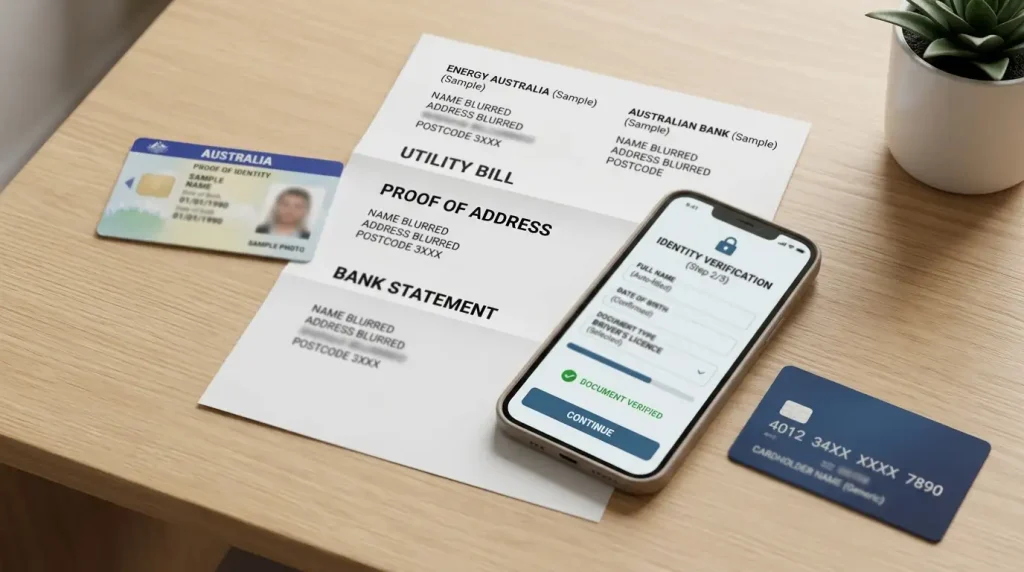
Rickycasino uses identity and contact checks as part of its KYC and anti-money-laundering process. The account journey can involve a valid identity document, proof of address and, in some cases, financial or source-of-funds information. The timing is important: a bitcoin user can meet a verification gate before play begins, while other checks can become decisive when a withdrawal is requested.
Table of Contents
- Account controls and responsible gambling sit alongside verification
- Verification starts with identity and address information
- Source-of-funds checks can deepen the review
- Bitcoin has a separate pre-play verification gate
- Withdrawal verification can hold a cashout before release
- Mobile access changes the screen, not the verification logic
- Where verification enters the user journey
- Questions about Rickycasino account verification
- Verification timing is the key account detail to understand
Account controls and responsible gambling sit alongside verification
Rickycasino describes personal limits and self-exclusion among its responsible-gambling tools. Those controls are separate from KYC, but they sit in the same account environment and affect how a user manages access, spending and session boundaries.
That distinction matters because verification answers a different question from responsible-gambling controls. KYC is about confirming identity, contact details and, where requested, financial information. Limits and self-exclusion are behavioural controls intended to help a user reduce or stop gambling activity.
- Identity checks can require an accepted ID document.
- Address checks can require proof of the residential address attached to the account.
- Financial checks can extend to source-of-funds information when requested.
- Account controls include personal limits and self-exclusion tools described by the casino.
For Australian readers, the site-level legal position is explained separately in the license guide. The practical account point here is narrower: opening and using an account can involve checks at more than one stage, so verification should be treated as part of the account workflow rather than as a single one-time screen.
Verification starts with identity and address information
Rickycasino’s AML and privacy materials describe identity and contact verification that can include ID and proof of address. These are standard categories of evidence for matching an account to a real person and checking that account details are consistent.
The exact document requested can vary with the account and the reason for the check, so the useful way to prepare is by category rather than by assuming one fixed document list. A government-issued identity document addresses who controls the account, while a recent address document addresses where that person resides.
| Check area | What Rickycasino may request | Why it matters in the account flow |
|---|---|---|
| Identity | Valid identification | Links the account to the named user and can be required before specific activity. |
| Address | Proof of address | Supports the residential details held on the account. |
| Financial background | Financial or source-of-funds information | Can extend the review beyond basic identity where AML checks require more context. |
| Withdrawal readiness | Completed account verification | A withdrawal or refund can remain on hold until the requested checks are complete. |
The practical consequence is that a successful registration does not necessarily mean every later transaction can proceed without further checks. Verification can be triggered or expanded as account activity changes.
Source-of-funds checks can deepen the review
Rickycasino’s KYC and privacy materials allow financial and source-of-funds information to be requested. That moves the process beyond simple identity matching because the casino can ask for context around the origin of money used on the account.
A source-of-funds request should be read as a separate layer rather than as another name for proof of identity. Identity evidence answers who the user is; source-of-funds evidence addresses the money connected with the account. The two can therefore appear together in a more detailed review.
- The account holds personal and contact details supplied during registration and use.
- ID and address evidence can be requested to match those details to the user.
- Financial information can be requested when the review needs more context about the funds involved.
- Transactions can remain pending while the required review is completed.
This sequence is especially relevant when planning a withdrawal. A user who only considers verification after submitting a cashout can encounter a hold at the point where money is expected to move. The withdrawal guide explains how verification interacts with the broader cashout sequence.
Bitcoin has a separate pre-play verification gate
Rickycasino’s terms state that valid ID is required before BTC play. Bitcoin deposits and bets are blocked until that verification is completed. This creates a different timing point from a later withdrawal review: for BTC use, the identity gate can arrive before the user funds or plays through the bitcoin route.
The consequence is straightforward. A user considering BTC should not assume that crypto automatically means a lighter account-check path. On Rickycasino’s stated terms, bitcoin can make verification relevant earlier in the journey.
This also connects the account page to the cashier. Rickycasino supports both fiat and crypto currencies, including BTC, ETH, USDT, LTC and DOG. The payment guide covers the available rails; the account-side point is that BTC has an explicit pre-play identity condition in the terms.
The BTC rule is also useful for distinguishing two ideas that are often conflated: payment technology and account identity. A blockchain transfer can be technically separate from a bank or card payment, but the casino can still require identity checks before allowing that rail to be used for play.
Withdrawal verification can hold a cashout before release
Rickycasino’s bonus terms state that account verification must be completed before a withdrawal request, while the broader terms allow a refund or withdrawal to remain on hold pending KYC. That makes verification a practical cashout dependency rather than an administrative detail.
A withdrawal therefore has more than one stage. The user submits the request, the account and transaction can be reviewed, approval can occur, and the payment method then has its own processing path. For card refunds, Rickycasino states that post-approval processing typically takes 5–7 banking days.
That timeline explains why a payment-method label should not be treated as a complete payout promise. A cashier can describe a method as fast at the rail level while an account review still has to finish before funds are released. Account verification and payment processing are separate parts of the same cashout journey.
For users comparing the order of events, the most useful distinction is between a pre-play gate and a withdrawal gate. Bitcoin can trigger the first. A later cashout can trigger or depend on the second. Source-of-funds questions can add a deeper review layer at either point when the account activity requires it.
Mobile access changes the screen, not the verification logic
Rickycasino supports responsive mobile web use, and its Australian copy also references a Rickycasino Mobile App. The practical account requirements do not become a separate system simply because the user changes device: identity, address, BTC pre-play and withdrawal checks remain account-level conditions.
On a phone, the main practical issue is document handling. Clear photographs, readable details and consistent account information matter because a verification request still depends on the quality of the submitted evidence. Moving between desktop and mobile does not remove the need for the account details and documents to match.
The account therefore works best as a continuous record across devices. Payment choice, game access and withdrawal status all feed back into the same user profile rather than creating a separate account state for each device.
Where verification enters the user journey
The clearest way to understand Rickycasino verification is to map each check to the point where it can affect the user. Basic ID and address evidence support the account itself. Source-of-funds requests add a deeper financial layer. BTC has an explicit pre-play ID requirement. Withdrawals can remain on hold until KYC is complete.
- Before or during account use: identity and contact information can be checked.
- When deeper AML context is needed: financial or source-of-funds information can be requested.
- Before BTC play: valid ID is required under Rickycasino’s terms.
- Before cashout completion: the account can need full verification, and a refund or withdrawal can remain pending while checks are completed.
This structure gives users a better planning model than treating KYC as one isolated event. Verification can reappear because each stage is tied to a different operational question: who controls the account, where the user resides, where funds come from and whether a withdrawal is ready to be released.
Questions about Rickycasino account verification
What documents can Rickycasino request for KYC?
Rickycasino’s KYC process can include valid ID and proof of address, and financial or source-of-funds information can also be requested.
Is verification required before playing with BTC?
Yes. Rickycasino’s terms state that valid ID is required before BTC play and that bitcoin deposits and bets are blocked until verification is completed.
Can verification delay a withdrawal?
Yes. A refund or withdrawal can remain on hold pending KYC, and the account can need full verification before the cashout process is completed.
Does Rickycasino have responsible-gambling account controls?
Yes. Rickycasino describes personal limits and self-exclusion among its responsible-gambling tools.
Verification timing is the key account detail to understand
Rickycasino’s account checks are most useful when viewed as a sequence rather than a single checkpoint. ID and address evidence form the base, source-of-funds requests can deepen the review, BTC introduces a pre-play verification gate, and withdrawals can remain pending until KYC is complete. That timing affects how smoothly deposits, play and cashouts move through the same account, so document readiness matters most before the transaction stage where a hold would be costly or frustrating.